
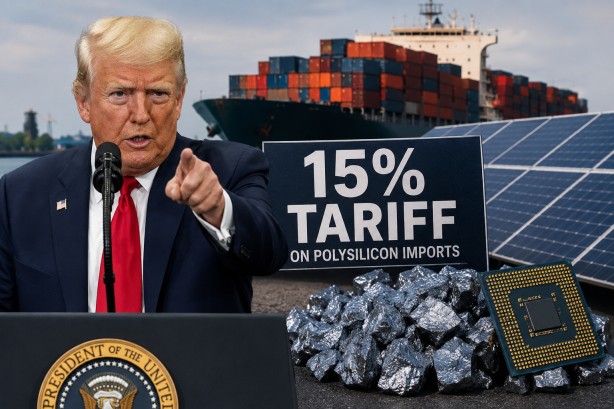
In a move to bolster domestic industries, US President Donald Trump has mandated a 15% tariff on imported goods containing polysilicon, which is crucial for semiconductor and solar panel production. The measure, set to commence on December 4, aims to decrease the US’s dependence on China, the globe’s largest polysilicon producer. Polysilicon, an ultra-pure form of silicon, is essential in creating semiconductors that power AI systems and data centers, as well as in manufacturing solar cells and panels.
The new policy stipulates specific minimum import prices: $21 per kilogram for polysilicon, $100 per kilogram for polysilicon ingots and wafers, $0.22 per watt for solar cells, and $0.38 per watt for solar modules and panels. According to the US administration, these measures are designed to ensure the commercial viability of domestic polysilicon production and to fortify critical supply chains that are integral to both economic stability and national security.
China has expressed disapproval of the US’s decision, claiming that it inappropriately uses national security as a justification to limit Chinese business activities. Chinese officials have also cautioned that such protectionist policies could lead to disruptions in trade relations between the two nations.
Currently, the United States hosts two significant polysilicon production facilities: Hemlock Semiconductor in Michigan and Wacker Chemie in Tennessee. The new tariff policy includes provisions for the US government to offer incentives to companies that choose to invest in domestic polysilicon and related manufacturing capabilities, potentially expanding this industrial base.
This tariff announcement arrives amid China’s continued robust growth in exports, especially in sectors like electronics and AI-related products, underscoring the high value of its manufacturing outputs. By implementing these tariffs, the US hopes to reclaim some of the market share in these crucial sectors and ensure a more self-reliant production landscape.